You’ve mixed, folded, shaped and baked your sourdough. Now comes the moment of truth: slicing into the loaf.
The crumb—the soft inside of the bread—can give you clues about how fermentation went. But it’s not a pass-or-fail test, and one big hole doesn’t automatically mean you’ve baked the perfect loaf. The flour, dough hydration, shaping and handling all affect the result too.
What does fermentation do?
During fermentation, the yeast in your starter produces gas. The dough’s gluten network holds onto some of that gas, helping the loaf rise and form its crumb. How well the dough rises depends on both the gas it produces and how well the dough can hold it.
Fermentation takes time, and the right timing changes with your starter, recipe and kitchen temperature. That’s why it helps to look at the dough as it rises, rather than relying only on a set number of hours.
Signs your loaf may be under-fermented
Under-fermented dough hasn’t had enough time to rise and develop before baking. The baked loaf may be:
Dense or heavy, especially near the bottom
Uneven inside, with a few very large holes surrounded by tighter areas
Tight and slightly gummy, even when fully baked
Less airy and springy than you hoped
A few larger holes by themselves don’t prove that the dough was under-fermented. Dough handling and shaping can also create uneven pockets.
Signs fermentation may be about right
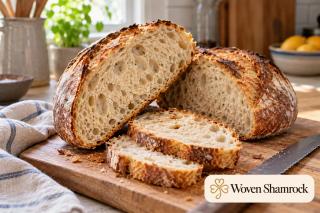
A nicely fermented loaf often has bubbles that are more evenly spread through the crumb. It may feel lighter, with a soft and springy texture when you press a slice.
Your ideal crumb is a matter of preference. Some bakers enjoy a closer, more even crumb for toast and sandwiches; others prefer a looser crumb with bigger holes. You don’t need giant air pockets for your bread to be delicious.
Signs your loaf may be over-fermented
If dough ferments for too long, its structure can weaken. The loaf may spread out or collapse instead of holding its shape, and the crumb may look compressed or fragile. Over-fermentation can affect the dough’s ability to hold gas and keep its structure.
A flat loaf isn’t always proof of over-fermentation, though. A weak starter, shaping difficulties or flour with less strength can also affect the result.
A helpful way to use the chart
Think of the crumb chart as a guide to patterns—not a strict scorecard. For a more useful comparison:
Let the loaf cool fully before slicing.
Look at the crumb from the centre of the loaf.
Notice whether the bubbles are mostly even, very uneven or compressed.
Think about how the dough looked and felt before baking.
Change one thing at a time with your next loaf, such as fermentation time or dough temperature.
If you want a lighter crumb, a strong starter and careful handling can help. But an open crumb also depends on things like flour strength and how the dough is shaped, so fermentation is only one part of the picture.
Five sourdough crumb questions
1. Does a big hole mean my loaf is perfect?
No. A large hole can happen when gas gathers unevenly in the dough. Look at the overall crumb and the loaf’s texture as well.
2. Why is my bread gummy inside?
It may be under-fermented, under-baked or sliced while still warm. Let the loaf cool completely before deciding what to adjust.
3. Can I tell if dough is ready by the clock?
Time is a helpful guide, but dough temperature and starter strength can change how quickly it ferments. Watch how much the dough rises and how it feels.
4. Do I need a very open crumb?
No. A closer, even crumb is lovely for everyday toast and sandwiches. Choose the texture you enjoy eating.
5. Should I change my recipe after one loaf?
First note what happened. Then adjust just one part of your process on the next bake, so you can see whether that change helped.
A small sourdough challenge
For your next loaf, write down when you mixed the dough, how warm the kitchen was, how much the dough rose, and what the crumb looked like after cooling. Keep the note with your recipe. A few bakes will help you learn how your dough behaves.
Every loaf teaches you something. Even the dense ones still make excellent toast.